Author: Rob Fitzpatrick
Published: 2013
About: This book is about how to properly talk to customers and learn from them.
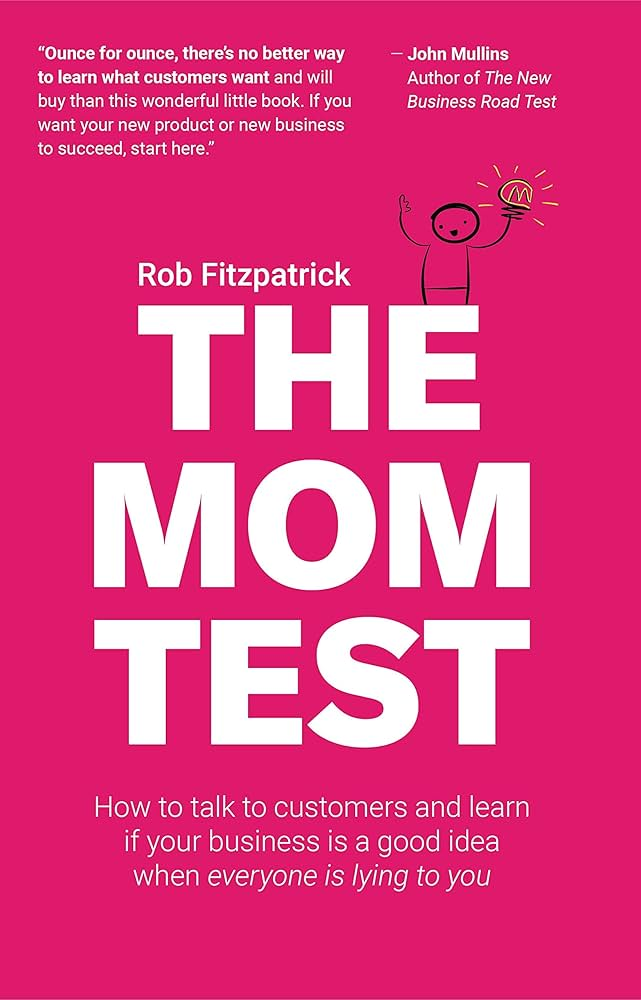 The Mom Test - Rob Fitzpatrick
The Mom Test
The name of the book comes from a typical startup-in-the-making situation. You come up with an idea and ask your mother whether that idea sounds good to her. Your mom will, to protect your feelings, acknowledgingly say yes and you will leave the conversation with the impression that the idea is really a potential to build a business around.
The author of this book not only says this approach is a bad idea, but that the whole question, as it is phrased right now, isn’t going to bring you closer to the truth. He gives a bunch of interesting could-happen conversation scenarios as well as tips and tricks on how to phrase questions to bring yourself closer to the truth and find an answer to the original question.
The Mom Test is a simple thought experiment which author uses as a basis to provide a set of simple rules for crafting good questions that even your mom can’t lie to you about.
One should wait for as long as possible before introducing their idea into the conversation to prevent the potential customer to slip into playing the fake politeness game just to avoid the awkward situation of trashing potentially bad idea.
For example, questions like “Do you think it’s a good idea?” or “Would you buy a product which did X?” are bad in terms of validating your idea since opinions are worthless (market will determine whether or not the idea is good) and people tend to be over-optimistic about their future behaviour.
On the other hand, questions like “How are you dealing with it now?” and “Talk me through the last time that happened?” are providing a valuable introspection into customer’s existing habits and will probably be filled with a lot of valuable information since people like to talk about their life and problems.
The ultimate goal of the conversation is to learn as much as possible about the customer by
- asking about their life and goals
- focusing on specifics about their past behaviour
- skipping questions about their opinions about the future
- talking less and listening more.
Avoiding bad data
There are a lot of ways conversations with customers can go wrong. The outcome of the bad conversation is that you end up with a bunch of bad data. There are three flavours of bad data:
- Compliments
- Hypothetical statements about the future
- Ideas
The best way to avoid compliments is to not mention your idea at all. There is a potential danger of being overly excited about your idea that you start pitching it to the potential customer. This is not the right time to do it. The way to get back on track is to deflect compliments to your pitch by asking relevant questions about how they previously handled the problem your idea tends to solve. There is also a realistic scenario in which you discover that the issue you are trying to solve is not that big of a deal and there is no potential to build a business around it. This is also a good (although negative) conversation.
There are symptoms which help spot if the conversation went wrong because every response contains sneaky compliments. Saying, “I’m glad you liked it” in the meeting or thinking “That meeting went well” back at the office could mean that the conversation didn’t result in any valuable information.
The way to detect customer started using hypothetical statements about the future is to notice them talking about
- generic claims,
- future-tense promises,
- and hypothetical maybes.
This type of bad data is often materialized in statements such as “I would definitely buy that”. The way to escape this fluff is to trace back to their experiences and specifics of how things are already done.
The ideas are potentially dangerous since being at the startup one thing you have abundance of are the ideas. If people start to see the potential of what you are building they will be tempted to propose a bunch of new ideas to improve your product. The key reaction here is not to add those ideas to your to-do list, but to try to dig into the motivations behind the request. Also, good hunch for exploring further are strong emotions. If talking about something is making that person angry, or embarassed, or overjoyed, this could be a potential for further conversation.
Asking important questions
On the other hand, it is important to ask non-trivial questions. Non-triviality here comes in the form of questions whose answers could potentially break a business in a way you imagined it. Preparation for these kinds of questions includes distancing yourself from the idea to be open to the possibility that the customer will be able to provide you with a better answer. Also, at this point, it is crucial to figure out if the issue your idea is trying to tackle meets two conditions:
- whether the person we’re talking to is taking this matter seriously
- whether they are willing to pay for the solution.
Questions like “How much time do you spend on it each week?” and “What are you already doing to improve this?” are broad enough to prevent you from zooming in too early, but give you a chance to find a strong signal for the potential business.
Key takeaway here is to prepare 3 most important things to learn from a conversation with a given type of person
- customer
- industry expert
- key hires.
The goal here is to come up with those questions in calm environment and to point them at crucial aspect of the idea’s sustainability. Even if it means that their actual answers could prove your idea not to be worthwhile.
Keeping it casual
Conferences and industry meetups work wonders for getting people to talk about their issues in a quick and casual chat rather than a long, format meeting. In this way you
- strip down the expectations of anything coming out of the conversation,
- cut down the time to reach actual people and have a conversation with them,
- and expose yourself to extra learning due to serendipity of spontaneous conversations.